


Co-packaged Fiber Optic Connector With 32+ Fibers and 127µm Pitch
Teramount employs innovative detachable fiber-optic connector technology to support an industry-first hybrid connection of over 32 single-mode/polarization-maintaining (SM/PM) fibers with a pitch of just 127µm, delivering unmatched bandwidth density for co-packaged optics (CPO).
Driven by AI/ML and HPC applications, the demand for higher data rates places immense pressure on chipset data connectivity and miniaturization. CPO significantly reduces processor power consumption by bringing fiber connections closer to the processor—shortening electrical SerDes interfaces to just a few millimeters before connecting to photonic integrated circuits (PICs) and optical fibers. However, a core challenge for CPO lies in maintaining high bandwidth density via optical fibers while minimizing the processor package footprint.
Consider next-generation 102.4 Tbps CPO switches: these require over 2,000 single-mode fibers (based on the 400GBASE-DR4 standard) and up to 500 PM fibers (for external laser system connections) distributed across 16 or 32 PICs—with each PIC handling 64–128 SM fibers and 4–8 PM fibers to achieve capacities of 6.4 Tbps or 3.2 Tbps, respectively.
Current fiber connection methods typically connect a limited number of fibers (approximately 12–16) to silicon photonics (SiPh) chips at a 250µm pitch; this results in extremely low bandwidth density, making them unsuitable for CPO packaging. Increasing bandwidth density using existing methods is not feasible for the following reasons:
- Reducing the fiber pitch from 250 µm to 127 µm will cause the fibers to sit lower within the V-grooves, thereby losing core-height alignment with the SiPh waveguides.
- Increasing the number of fibers/V-grooves per PIC results in sensitivity to fiber shifting due to thermal expansion during reflow and high-temperature operations, as well as to wafer bending, which again makes it very difficult to maintain alignment of the fiber core with the SiPh waveguide.
Teramount’s unique SiPh chip-to-fiber connectivity solution utilizes the TeraVERSE® detachable fiber connector, offering a 127µm fiber pitch and supporting a mix of over 32 SM/PM fibers per connector; its modular socket design allows multiple connectors to interface with a single PIC, delivering high scalability capable of supporting the largest and densest PICs and processors.
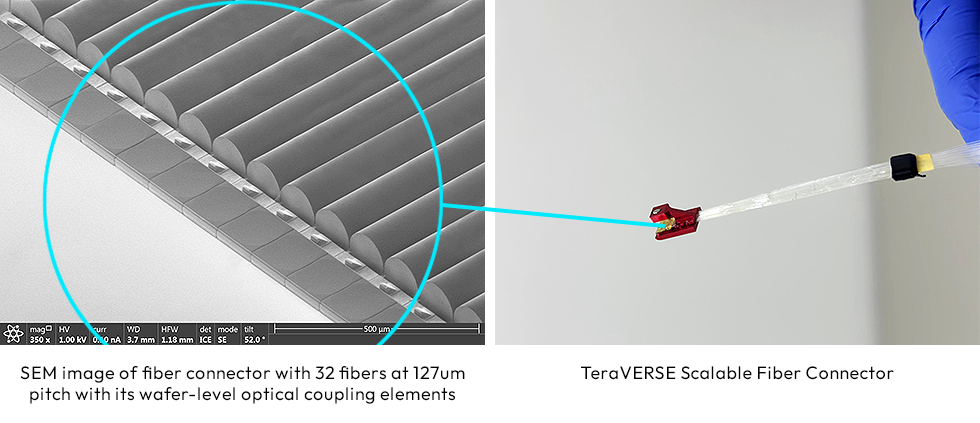
TeraVERSE employs an innovative broadband surface-coupling solution that leverages wafer-level manufacturing processes to create Teramount’s self-aligning optical scheme. This approach enables unprecedented assembly tolerances, which are critical for achieving fully passive, detachable, high-density fiber-optic connectors.
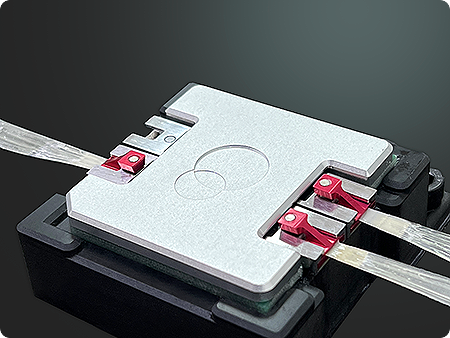
This planar separation between the optical fibers and the PIC/waveguide enables the use of dense fiber spacing and a large number of fibers without concerns regarding PIC warping or thermal shifts (since the fibers are connected to the PIC only after the reflow process is complete).
As the pursuit of ever-increasing data capacity and transmission rates continues, bandwidth density has become a critical challenge that next-generation high-performance processors must address. Teramount’s TeraVERSE delivers unmatched bandwidth density and scales easily to meet both current and future bandwidth requirements.
[Responsible Editor]:kyomori-ka Copyright:www.kyomori-ka.com Please indicate the source when reprinting
[Disclaimer]: Part of the information on this website comes from the Internet. If you find any work infringing your intellectual property rights, please contact us to modify or delete it.